Optimal Design of Hybrid Renewable Energy System (PV/Wind/PHS) Under Multiple Constraints of Connection to the Electricity Grid: A Case Study
DOI:
https://doi.org/10.63318/waujpasv4i1_09Keywords:
Solar Energy, Wind Energy, Hydropower, Hybrid Energy Systems, Electrical Loads, LibyaAbstract
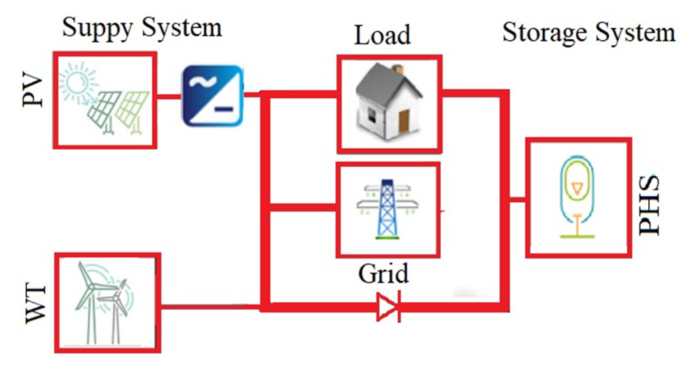
Libya faces a challenge in providing a secure and stable electricity supply. The deficit recorded in 2024 reached approximately 32.5%, forcing the General Electricity Company to resort to rationing, with power cuts lasting up to eight hours daily. The country's strategic vision aims to overcome this problem by transitioning to renewable energy sources and adopting decentralized generation systems. This approach is clearly embodied in the National Energy Strategy for the period 2025–2050, which aims to increase the share of renewable sources in the overall energy mix to more than 50% by 2050. In this context, this research paper proposes the design of an integrated hybrid renewable energy system, combining photovoltaic cell and wind turbine technologies, supported by a pumped hydroelectric storage (PV/Wind/PHS) system. The study results showed that the ideal system configuration consists of a 1000 MW solar photovoltaic field and a 200 MW wind farm, integrated with an 854 MWh storage system. This system generates a total annual energy output of approximately 1515.761 GWh, fully covering the current electricity deficit estimated at around 15575 MWh. The system also injects energy into the national grid, adhering to the grid's protocol, which stipulates that no energy is drawn from the grid during a deficit and no energy is exported to it during a saturated period, and vice versa. The optimized design achieves 100% sustainable load supply and records the lowest levelized power cost of $49.9/MWh. The project cost is estimated at approximately $19.923 billion, with a payback period of 11.10 years. The proposed system also contributed to reducing carbon emissions by 11,624 kilotons, saving an estimated $816.246 million in emissions-related social costs, in addition to an estimated $2.189 billion in savings resulting from reduced conventional fuel consumption.
Downloads
Published
Issue
Section
License
Copyright (c) 2026 The authors

This work is licensed under a Creative Commons Attribution-NonCommercial 4.0 International License.
This journal uses Creative Commons Attribution-Noncommerical 4.0 International License (CC BY-NC 4.0), which permits use, sharing, adaptation, distribution and reproduction in any medium or format, as long as you give appropriate credit to the original author(s) and the source, provide a link to the Creative Commons license, and indicate if changes were made. To view a copy of this license, visit https://creativecommons.org/licenses/by-nc/4.0/.
Copyright of articles
Authors retain copyright of their articles published in this journal.