Dynamic versus Quasi-Steady-State Simulation of Shading Strategies for Cooling Load Reduction: A Case Study of an Educational Building in Tripoli, Libya
DOI:
https://doi.org/10.63318/waujpasv4i2_27Keywords:
Exterior Shading Devices, Cooling Load, Heating Load, EnergyPlus, Dynamic Simulation, Quasi-Steady-State Simulation, Educational Buildings, Tripoli, LibyaAbstract
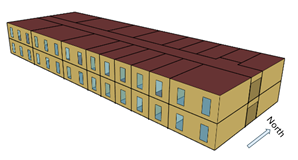
Buildings account for roughly 32% of global final energy consumption, and cooling represents the largest share of that demand in hot-arid climates, where educational buildings are particularly energy intensive due to long daily occupancy. This study evaluates five exterior shading configurations, a horizontal overhang, fixed horizontal louvers, louvers inclined at 15° and 30°, and an overhang combined with vertical fins, applied to the southern facade of a two-story, 1600 m² educational building at the University of Tripoli, Libya. The building was modeled in HAP, which applies a quasi-steady-state method, and in EnergyPlus (with SketchUp/OpenStudio), which applies a dynamic transient heat-balance method. A base case without shading was simulated in both tools before each shading system was applied in EnergyPlus. For the July design day, EnergyPlus predicted a peak cooling demand of 181.9 kW against 165 kW from HAP, 10.2% higher; for June, EnergyPlus predicted a total cooling consumption of 20,452 kWh against 38,268 kWh from HAP, 46.56% lower. For January, EnergyPlus predicted a peak heating load of 11.77 kW against 10.5 kW from HAP (12.1% higher) and a heating consumption of 10.56 kWh against 10,189 kWh from HAP (99.9% lower), reflecting HAP's tendency to average loads rather than resolve hourly transients. Among the shading systems, the 30° inclined louvers gave the largest annual cooling reduction (10.27%, from 136,886 to 122,833 kWh) and the largest peak demand reduction (1.51%), followed by 15° louvers (9.81%), horizontal louvers (9.10%), overhang with fins (7.46%), and the overhang alone (5.25%). Adopting this best performing system is estimated to avoid about 14.57 t CO2 per year, based on a national grid emission factor of 1.037 kg CO2/kWh. All five systems increased annual heating consumption relative to the 147 kWh base case, up to 542 kWh (269%) for the 30° louvers, since the geometry that blocks summer solar gain also blocks winter solar gain. Shading selection should balance cooling savings against this heating penalty, and dynamic simulation should be preferred over quasi-steady-state tools when peak and part-load performance matter.
Downloads
Downloads
Published
Issue
Section
License
Copyright (c) 2026 The authors

This work is licensed under a Creative Commons Attribution-NonCommercial 4.0 International License.
This journal uses Creative Commons Attribution-Noncommerical 4.0 International License (CC BY-NC 4.0), which permits use, sharing, adaptation, distribution and reproduction in any medium or format, as long as you give appropriate credit to the original author(s) and the source, provide a link to the Creative Commons license, and indicate if changes were made. To view a copy of this license, visit https://creativecommons.org/licenses/by-nc/4.0/.
Copyright of articles
Authors retain copyright of their articles published in this journal.