A Tunable One-Parameter Derivative-Free Secant-Type Method with Quadratic Convergence for Solving Nonlinear Equations
DOI:
https://doi.org/10.63318/Keywords:
New modified, Nonlinear equations, Quadratic convergence, Roots, Secant methodAbstract
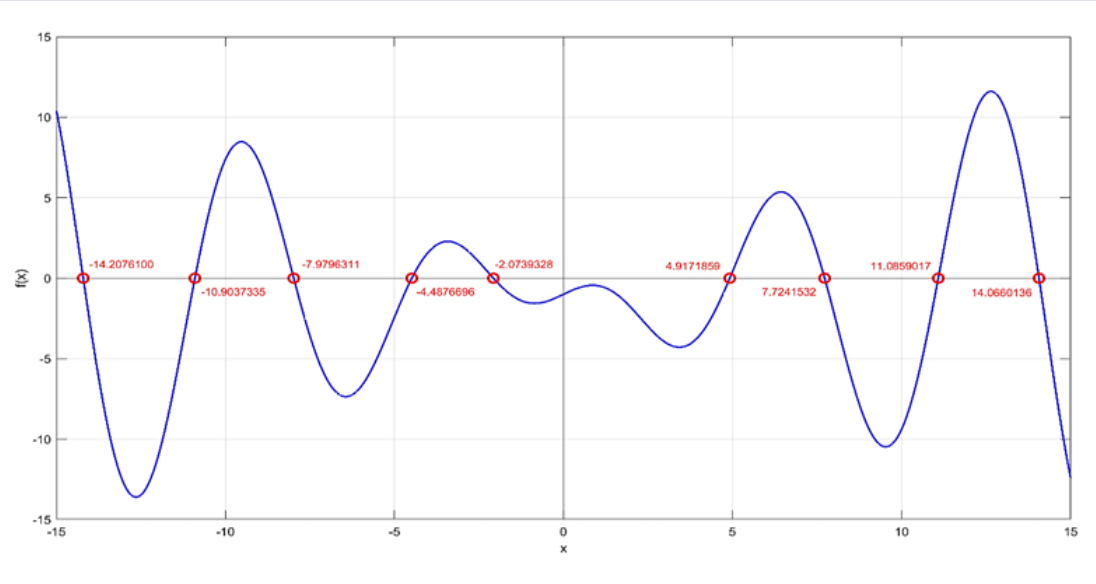
Nonlinear equations arise across a wide range of scientific and applied disciplines, yet closed-form analytical solutions are often unattainable. The classical Secant Method remains a popular choice because it avoids derivative evaluation, although its superlinear convergence rate can be comparatively slow. To overcome this limitation, we introduce a modified secant-type method that retains the algorithm's original simplicity, requires only two initial approximations, and incorporates a single tunable parameter. Convergence analysis shows that the proposed method preserves superlinear convergence in general and attains quadratic convergence as the parameter approaches unity. Numerical experiments on a variety of nonlinear equations, tested under several initial approximations, demonstrate that the method converges efficiently and reliably to the exact root—in contrast to Newton's method and the three-point Secant method, both of which fail to converge in certain cases. Moreover, for equations with multiple roots, fixing the initial approximations while varying the tunable parameter causes the method to converge to different roots, underscoring the parameter's role in shaping the basins of attraction. By combining the derivative-free simplicity of the classical secant approach with convergence rates comparable to those of Newton's method and the three-point Secant method, the proposed technique offers a tunable, efficient, and reliable tool for solving nonlinear equations.
Downloads
Downloads
Published
Issue
Section
License
Copyright (c) 2026 The author

This work is licensed under a Creative Commons Attribution-NonCommercial 4.0 International License.
This journal uses Creative Commons Attribution-Noncommerical 4.0 International License (CC BY-NC 4.0), which permits use, sharing, adaptation, distribution and reproduction in any medium or format, as long as you give appropriate credit to the original author(s) and the source, provide a link to the Creative Commons license, and indicate if changes were made. To view a copy of this license, visit https://creativecommons.org/licenses/by-nc/4.0/.
Copyright of articles
Authors retain copyright of their articles published in this journal.