Assessment of Bacterial Contamination on Non-Living Surfaces and Equipment at Sabratha Teaching Hospital
DOI:
https://doi.org/10.63318/waujpasv4i2_67Keywords:
Hospital Acquired Infection, Infection, Immunocompromised, Intensive care unit, Klebsiella, Pseudomonas aeruginosaAbstract
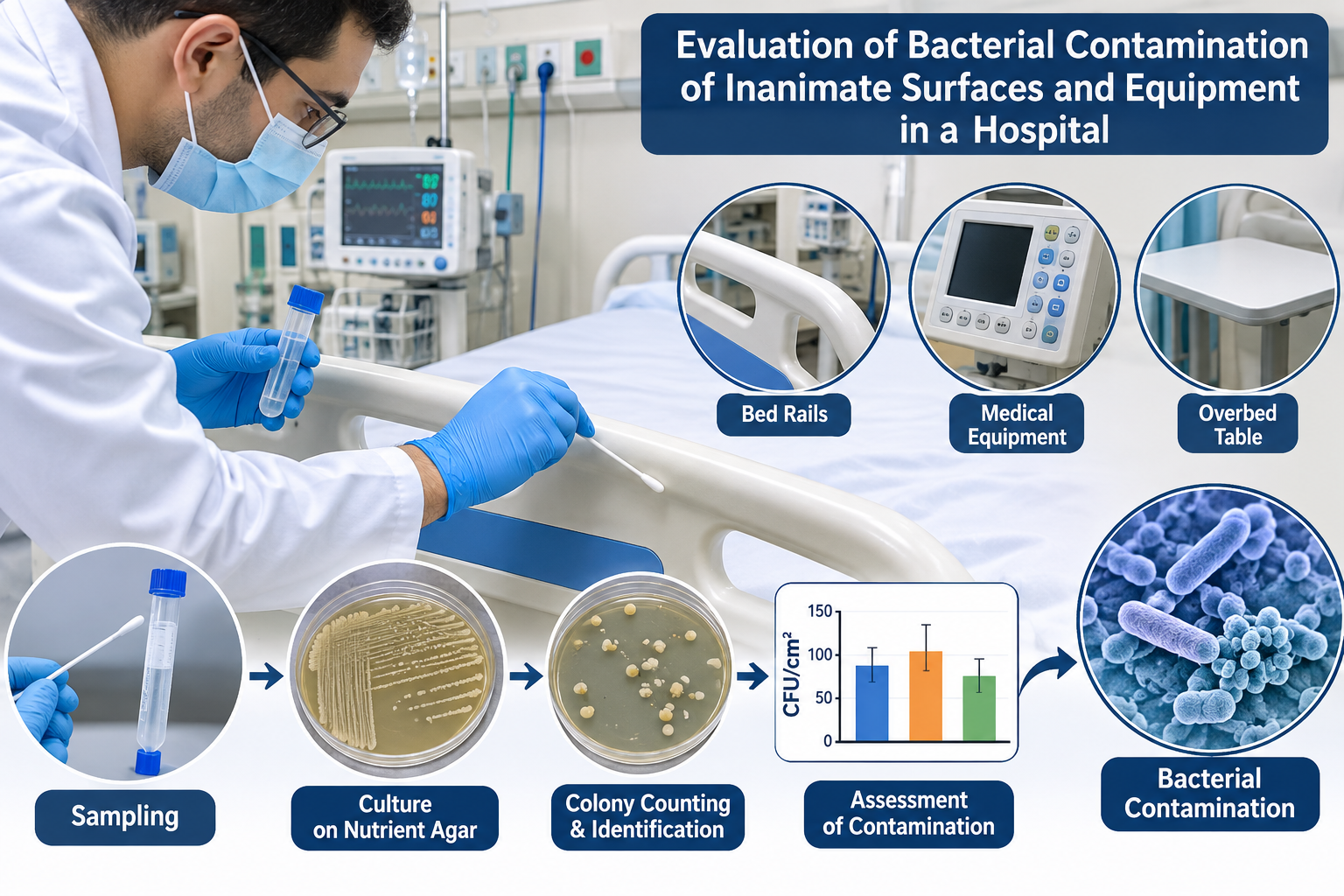
Due to their high rates of morbidity and mortality, hospital-acquired infections (HAIs) are a major worldwide health concern. Bacterial contamination of hospital surfaces and equipment has been recognized as a major means for nosocomial infection spread worldwide. The extent of contamination on surfaces and equipment in the various departments of Sabratha Teaching Hospital remains poorly understood, despite its importance. The purpose of this study is to evaluate the rate of bacterial contamination at Sabratha Teaching Hospital on inanimate surfaces and equipment, as well as its susceptibility to antibiotics. Methodology: From July to October 2025, a descriptive cross-sectional investigation was carried out in various hospital wards. The Sabratha Teaching Hospital served as the study's site. For this study, 70 swabs samples were taken from high-contact surfaces for inanimate surfaces and equipment including Emergency department, newborn intensive care unit, Orthopedics and orthopedic surgery department, Hemodialysis unit, obstetrics and Gynecology department, children s department, Intensive care unit, were grown on general media selective media, and enriched media, such as MacConkey agar and blood agar, in order to determine the types of bacteria found. The data was entered and analyzed using descriptive statistics. Results: Thirty-two samples (45.7%) showed bacterial growth. Gram-negative bacteria were the most prevalent among the identified bacteria, with Klebsiella spp being the most common, accounting for 12 samples (37.5%), followed by Pseudomonas aeruginosa with 8 samples (25%). As for Gram-positive samples, they were of the species Staphylococcus epidermidis, accounting for 12 samples (37.5%). Conclusion: Surfaces and equipment in various wards may contain a variety of harmful germs that could infect patients, particularly those who are critically ill or immunocompromised. Evaluating infection control procedures, putting in place routine disinfection programs, and educating medical personnel about the possibility of pathogen transfer from hospital surfaces and equipment are all essential to reducing this risk.
Downloads
Downloads
Published
Issue
Section
License
Copyright (c) 2026 Authors

This work is licensed under a Creative Commons Attribution-NonCommercial 4.0 International License.
This journal uses Creative Commons Attribution-Noncommerical 4.0 International License (CC BY-NC 4.0), which permits use, sharing, adaptation, distribution and reproduction in any medium or format, as long as you give appropriate credit to the original author(s) and the source, provide a link to the Creative Commons license, and indicate if changes were made. To view a copy of this license, visit https://creativecommons.org/licenses/by-nc/4.0/.
Copyright of articles
Authors retain copyright of their articles published in this journal.