Geothermal Energy Expansion in Non-Volcanic Regions: A Review of Enhanced Geothermal Systems (EGS)
DOI:
https://doi.org/10.63318/waujpasv4i2_72Keywords:
Enhanced Geothermal Systems, EGS, Hydraulic stimulation, Deep geothermal, Induced seismicity, Superhot rockAbstract
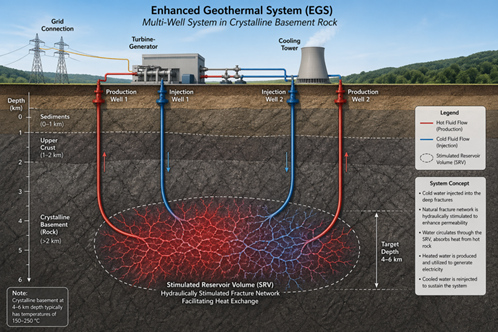
Enhanced Geothermal Systems (EGS) is a game changer to utilizing geothermal energy in areas that do not have traditional hydrothermal resources. This literature review presents the existing developments in EGS technology including reservoir stimulation, thermal-hydraulic-mechanical-chemical (THMC) modeling, drilling innovations, power conversion systems, and seismic risk management. We discuss EGS projects around the world, such as Soultz-sous-Forêts (France), Cooper Basin (Australia), Pohang (South Korea), Project Cape (by Fervo Energy) (United States), and FORGE (Utah, USA) to draw the conclusions which can be used in the large-scale application. The article measures the theoretical resource base of EGS (over 10,000 EJ can be recovered in the United States alone), model levelized cost of energy (LCOE), and assesses key technical constraints such as well productivity, reservoir life, and induced seismicity. New technologies such as superhot rock (SHR) geothermal, machine-learning-controlled drilling, and distributed acoustic sensing (DAS) are examined in terms of how they can speed up the commercialization process. We find that EGS might be able to deliver 8.5 percent of world electricity by 2050 in favorable learning-rate conditions, but it will take long-term R&D, permit streamlining, and innovative financing systems. The review serves as an excellent resource to researchers, engineers, and policymakers moving about in the new EGS terrain.
Downloads
Downloads
Published
Issue
Section
License
Copyright (c) 2026 The authors

This work is licensed under a Creative Commons Attribution-NonCommercial 4.0 International License.
This journal uses Creative Commons Attribution-Noncommerical 4.0 International License (CC BY-NC 4.0), which permits use, sharing, adaptation, distribution and reproduction in any medium or format, as long as you give appropriate credit to the original author(s) and the source, provide a link to the Creative Commons license, and indicate if changes were made. To view a copy of this license, visit https://creativecommons.org/licenses/by-nc/4.0/.
Copyright of articles
Authors retain copyright of their articles published in this journal.