Review of Synergistic Thermal Management in Photovoltaic/Thermal (PV/T) Systems: Nanofluids, Phase-Change Materials, and Finned Structures
DOI:
https://doi.org/10.63318/Keywords:
PV/T, Nanofluid, Phase-change material, Internal fins, Thermal management, LibyaAbstract
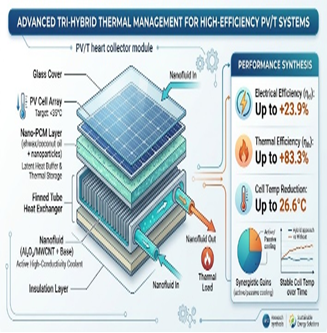
Operating temperature surges pose a major operational barrier to photovoltaic (PV) performance, causing significant declines in electrical output. Advanced thermal management approaches including Phase Change Materials (PCM), nanofluids, and structural modifications (fins/heat sinks) have emerged as viable mitigation pathways. However, existing literature frequently examines these technologies in isolation. In this paper, a critical evaluation of two review articles published in 2026 collectively citing 24 recent scientific studies—was conducted. The comparative analysis was carried out using the 16 papers most pertinent to the synergistic ternary hybrid ('Tri-Hybrid') system This paper provides a comparative synthesis of recent studies on active and passive cooling enhancements, merging comparative datasets across diverse configurations. By integrating structural enhancements (lapping fins and metal foams), high-conductivity nanofluids (Al₂O₃, MWCNT, Carbon Black), and latent heat storage (Paraffin wax, Coconut oil), this study evaluates the synergistic performance gains of multi-layered cooling systems, providing design insights for high-efficiency solar energy systems. To the best of the authors' knowledge based on literature up to 2026, no previous study has simultaneously integrated internal lapping fins, nanofluids, and PCMs within a single hybrid PV/T system—a novel synergistic approach expected to significantly boost both electrical and thermal. Ultimately, these advanced materials and hybrid frameworks present a durable pathway toward optimizing solar-to-thermal energy harvesting and storage.
Downloads
Downloads
Published
Issue
Section
License
Copyright (c) 2026 The authors

This work is licensed under a Creative Commons Attribution-NonCommercial 4.0 International License.
This journal uses Creative Commons Attribution-Noncommerical 4.0 International License (CC BY-NC 4.0), which permits use, sharing, adaptation, distribution and reproduction in any medium or format, as long as you give appropriate credit to the original author(s) and the source, provide a link to the Creative Commons license, and indicate if changes were made. To view a copy of this license, visit https://creativecommons.org/licenses/by-nc/4.0/.
Copyright of articles
Authors retain copyright of their articles published in this journal.