Approximate Analytical Solutions of the Time-Fractional Chen–Lee–Liu Equation Using the Asymptotic Homotopy Perturbation Method
DOI:
https://doi.org/10.63318/waujpasv4i2_45Keywords:
Time-fractional Chen-Lee-Liu Equation, Asymptotic Homotopy Perturbation Method, Caputo Fractional Derivative, Nonlinear Fractional PDEs, Residual Minimization, Least Squares MethodAbstract
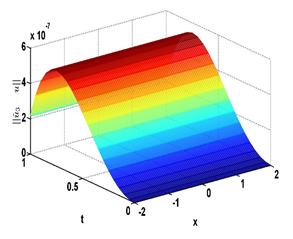
The time-fractional Chen–Lee–Liu equation is considered to be a special case of the time-fractional derivative nonlinear Schrödinger equation, which have found wide applications in nonlinear optics, particularly in the study of pulse propagation within optical fibers. This study investigates approximate analytical solutions of the time-fractional Chen–Lee-Liu equation using the Asymptotic Homotopy Perturbation Method (AHPM), with the time-fractional derivative defined in the Caputo sense. The proposed approach transforms the nonlinear fractional partial differential equation into a sequence of recursive problems whose solutions are constructed iteratively. The convergence-control parameters are determined through a least-squares minimization of the residual over the prescribed computational domain. The accuracy of the resulting truncated series is assessed by comparison with the exact solution available for the corresponding integer-order case. Numerical results, including absolute errors and residual norms for different fractional orders and truncation levels, demonstrate the convergence behaviour of the proposed approximation. The results indicate that AHPM can provide accurate approximate solutions for the considered time-fractional Chen-Lee-Liu model.
Downloads
Downloads
Published
Issue
Section
License
Copyright (c) 2026 Authors

This work is licensed under a Creative Commons Attribution-NonCommercial 4.0 International License.
This journal uses Creative Commons Attribution-Noncommerical 4.0 International License (CC BY-NC 4.0), which permits use, sharing, adaptation, distribution and reproduction in any medium or format, as long as you give appropriate credit to the original author(s) and the source, provide a link to the Creative Commons license, and indicate if changes were made. To view a copy of this license, visit https://creativecommons.org/licenses/by-nc/4.0/.
Copyright of articles
Authors retain copyright of their articles published in this journal.