مقارنة بين نمادج التعلم الالي للتنبأ بخطر الاصابة بالسكتة الدماغية
DOI:
https://doi.org/10.63318/waujpasv4i2_01الكلمات المفتاحية:
التصنيف، البرمجة الجينية، التعلم الآلي، النماذج الالية، التنبؤ بالسكتة الدماغيةالملخص
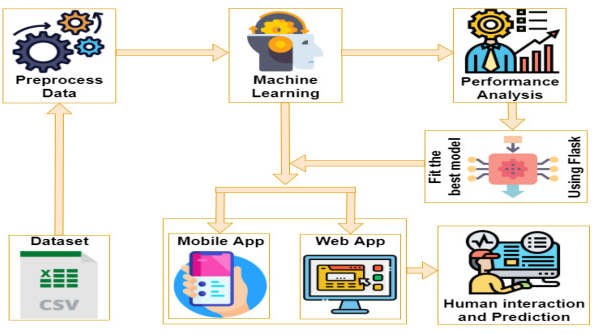
Stroke is a major cause of death and permanent disability globally. Effective preventive measures depend on early stroke risk prediction. This, study investigates a form of machine learning classifiers for predicting the risk of stroke and evaluates their performance in comparison to more conventional models, including Artificial Neural Networks (ANN), Logistic Regression (LR), Decision Trees (DT), Support Vector Machines (SVM), Naive Bayes (NB), K-Nearest Neighbors (KNN), AdaBoost, Gradient Boosting, and Genetic Programming (GP). A public dataset from DataHack comprising 4981 participants was used, with class imbalance addressed by using Synthetic Minority Over-sampling Techniques (SMOTE). The dataset was split into a training set with 80% and a testing set with 20%. According to the experimental results, all the proposed approaches performed well in all the presented categories. Moreover, the GP approach achieved the highest results among the proposed approaches, reaching 95.6% accuracy, a significant improvement over the 90% state-of-the-art accuracy. The GP approach delivers prediction accuracy by creating symbolic expressions that illustrate correlations between the probability of stroke and risk factors. This study highlights the potential of machine learning approaches in predictive healthcare applications while also emphasizing the need for improvements through hybrid approaches, parameter modifications, and practical medical integration.
التنزيلات
التنزيلات
منشور
إصدار
القسم
الرخصة
الحقوق الفكرية (c) 2026 المؤلف

هذا العمل مرخص بموجب Creative Commons Attribution-NonCommercial 4.0 International License.
تستخدم هذه المجلة رخصة المشاع الإبداعي-غير تجاري نَسب المُصنَّف 4.0 دولي (CC BY-NC 4.0)، والتي تسمح بالاستخدام والمشاركة والتوزيع والاستنساخ بأي وسيط أو صيغة، طالما أنك تعطي الفضل المناسب للمؤلف (المؤلفين) الأصلي والمصدر، وتوفر رابطًا لرخصة المشاع الإبداعي، وتشير إلى ما إذا تم إجراء تغييرات. للاطلاع على نسخة من هذا الترخيص، قم بزيارة /https://creativecommons.org/licenses/by-nc/4.0
حقوق الطبع والنشر للمقالات
يحتفظ المؤلفون بحقوق الطبع والنشر لمقالاتهم المنشورة في هذه المجلة.