Techno-Economic Feasibility of Parabolic Trough Solar Steam for Thermal Enhanced Oil Recovery
DOI:
https://doi.org/10.63318/waujpasv4i1_19Keywords:
Enhanced oil recovery, Solar energy, Thermal injection, Techno-economic analysis, Steam generation, Parabolic trough collectorAbstract
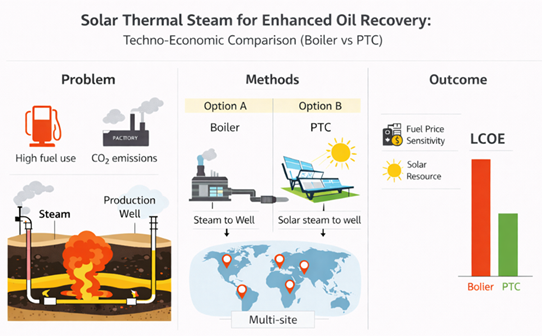
This study rigorously evaluates the techno-economic feasibility of parabolic-trough collector (PTC) for thermal enhanced oil recovery (EOR) by benchmarking it against conventional diesel-fired boiler steam supply across geographically diverse thermal- OR fields. Site-specific direct normal irradiance data from NREL’s NSRDB are used to characterize the solar resource and size the collector aperture area. Techno-economic calculations and scenario evaluation are conducted using HOMER Pro, while the proposed PTC configuration includes thermal energy storage with an equivalent duration of 6 h/day and is assessed under a representative capacity factor of 0.6, reflecting partial coverage of steam-load demand. A harmonized levelized cost of energy (LCOE) framework is applied to both configurations under consistent financial assumptions to enable an apples-to-apples comparison. Results show that boiler-based LCOE is strongly driven by local diesel pricing and heat-duty requirements the Netherlands (NLD) exhibits the highest boiler LCOE, whereas Venezuela (VEN1) yields the lowest. A second Venezuelan case (VEN2) produces an anomalously high boiler LCOE around 4.5, attributable to an exceptionally large reported heat duty; it is therefore treated as an outlier with elevated uncertainty. PTC investment inputs are parameterized using NREL benchmark unit costs 24.375 SAR/kW installation, 712.5 SAR/m2 solar field, and 93.75 SAR/kWh thermal storage. Beyond cost competitiveness, solar steam substitution provides a credible pathway for fuel displacement and associated CO2 mitigation; reported solar-EOR deployments indicate annual CO2 reductions ranging from 104 to 636,720 tCO2/year, depending on plant scale.
Downloads
Published
Issue
Section
License
Copyright (c) 2026 The authors

This work is licensed under a Creative Commons Attribution-NonCommercial 4.0 International License.
This journal uses Creative Commons Attribution-Noncommerical 4.0 International License (CC BY-NC 4.0), which permits use, sharing, adaptation, distribution and reproduction in any medium or format, as long as you give appropriate credit to the original author(s) and the source, provide a link to the Creative Commons license, and indicate if changes were made. To view a copy of this license, visit https://creativecommons.org/licenses/by-nc/4.0/.
Copyright of articles
Authors retain copyright of their articles published in this journal.