AI-Based Monitoring of Solar Panels in Desert Environments: Distinguishing Dust Accumulation for Fault Detection
DOI:
https://doi.org/10.63318/waujpasv4i1_38Keywords:
Artificial intelligence, Image classification, Solar cells, Dust, Fault monitoring, EfficiencyAbstract
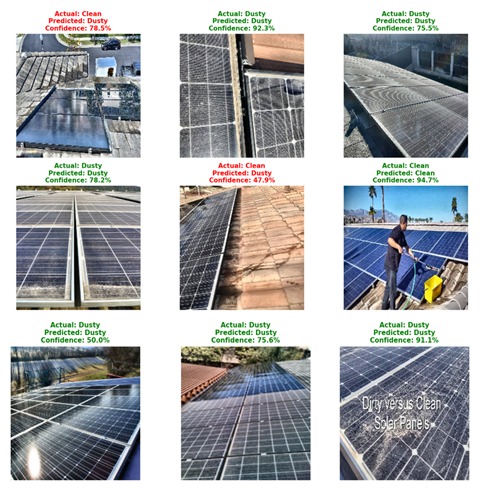
Dust accumulation on photovoltaic (PV) panels in arid and desert environments poses a significant challenge by degrading conversion efficiency and reducing overall energy yield. A comparative analysis was conducted using three supervised classifiers— ogistic Regression, Support Vector Machine (SVM), and Multi-Layer Perceptron (MLP)—trained and tested on a dataset comprising 2,562 PV images (1,493 clean and 1,069 dusty) obtained from Kaggle, a widely used data science and machine learning platform. The proposed pipeline integrates robust image pre-processing steps, including resizing to 224 × 224 pixels, contrast enhancement via Contrast Limited Adaptive Histogram Equalization (CLAHE), and RGB normalization. Feature extraction yielded 28 engineered descriptors encompassing grayscale intensity statistics, RGB and HSV (Hue, Saturation, Value) color characteristics, edge-based morphology, and texture information. Experimental results indicate that the SVM classifier outperformed the other models, achieving a validation accuracy of 75.78% and a test accuracy of 74.07%, with balanced precision and recall values of 74.00% and 74.07%, respectively. Notably, the model demonstrated higher recall for clean panel detection (79%) compared to dusty panels (68%), highlighting the complexity associated with detecting varying degrees of soiling. Furthermore, the SVM achieved an area under the Receiver Operating Characteristic (ROC) curve of 0.790 while maintaining low computational complexity. The results demonstrate that the proposed SVM-based approach is a practical and efficient solution for automated solar panel monitoring in desert environments, enabling timely maintenance and reducing energy losses.
Downloads
Published
Issue
Section
License
Copyright (c) 2026 The authors

This work is licensed under a Creative Commons Attribution-NonCommercial 4.0 International License.
This journal uses Creative Commons Attribution-Noncommerical 4.0 International License (CC BY-NC 4.0), which permits use, sharing, adaptation, distribution and reproduction in any medium or format, as long as you give appropriate credit to the original author(s) and the source, provide a link to the Creative Commons license, and indicate if changes were made. To view a copy of this license, visit https://creativecommons.org/licenses/by-nc/4.0/.
Copyright of articles
Authors retain copyright of their articles published in this journal.