Performance Evaluation of a Standalone PV-Hydrogen Power System for Continuous Supply Reliability in Brack Al-Shatti
DOI:
https://doi.org/10.63318/waujpasv4i1_40Keywords:
Green hydrogen, Standalone PV systems, Energy storage, Techno-Economic-Energy-Environmental analysis, CO2 footprint mitigation, LibyaAbstract
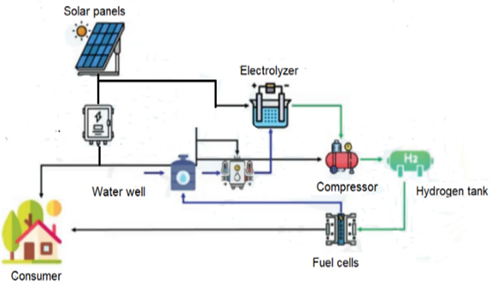
This study aims to evaluate the techno-economic feasibility of a standalone (off-grid) energy system in Brack Al-Shatti, utilizing a green hydrogen production and recovery cycle as a long-duration energy storage solution, aligned with the National Vision 2050 and the Paris Climate Agreement. The methodology employs a precise energy balance integration, featuring a 511.1 MW photovoltaic field supplying a 198.4 MW electrolyzer, coupled with a hydrogen storage capacity of 20,704 m³ at an operating pressure of 100 bar. To ensure operational reliability and uninterruptible supply, the system is reinforced with a 171.5 MW fuel cell and a 227.5 kW Reverse Osmosis (RO) desalination unit to provide the high-purity water essential for the electrochemical process. The results demonstrate the system’s capability to fully meet the target annual electrical load of 590,018 MWh with 100% self-reliance. Despite substantial capital expenditures (CAPEX) estimated between $1.52 and $2.96 billion, the financial analysis reveals a competitive Levelized Cost of Energy (LCOE) of approximately $0.097/kWh when environmental credits are integrated. Environmentally, the system prevents the emission of 611,850 tons of CO2 annually, generating an indirect fiscal saving exceeding $52 million. The study concludes that the success of this model in Brack Alshatti serves as a cornerstone for transforming Southern Libya from an energy- consuming region into a regional hub for clean energy exportation, contingent upon global technology price flexibility and local logistical infrastructure development.
Downloads
Downloads
Published
Issue
Section
License
Copyright (c) 2026 The authors

This work is licensed under a Creative Commons Attribution-NonCommercial 4.0 International License.
This journal uses Creative Commons Attribution-Noncommerical 4.0 International License (CC BY-NC 4.0), which permits use, sharing, adaptation, distribution and reproduction in any medium or format, as long as you give appropriate credit to the original author(s) and the source, provide a link to the Creative Commons license, and indicate if changes were made. To view a copy of this license, visit https://creativecommons.org/licenses/by-nc/4.0/.
Copyright of articles
Authors retain copyright of their articles published in this journal.