Dual-Fluid Compressed Air Energy Storage for Renewable Integration: Thermodynamic Modeling and Performance Evaluation
DOI:
https://doi.org/10.63318/waujpasv4i1_47Keywords:
Compressed air energy storage, Dual fluid system, Dynamic simulation, Round trip efficiency, Renewable integrationAbstract
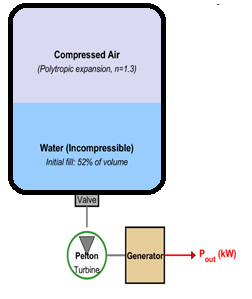
he increasing use of renewable energy sources such as wind and solar introduces fluctuations that make it more difficult to maintain a continuous balance between electricity generation and consumption. Energy storage systems play a critical role in addressing this challenge by storing excess energy and supplying it when needed. In this study, a hybrid storage approach known as Dual-Fluid Energy Storage (DFES) is investigated. The system combines compressed air with a water-based hydraulic mechanism, where energy is recovered through a Pelton turbine. A thermodynamic model based on polytropic behavior was developed and simulated using MATLAB/Simulink to analyze system performance under various operating conditions. The results show that a storage tank with a volume of 10 m³ at a pressure of 10 atm can provide an output of 100 kW for about 30 minutes, or maintain 10 kW for nearly 7 hours. When system losses are considered, the overall efficiency is calculated to be approximately 64%. The analysis also reveals that an initial water fill level of around 52% yields the highest usable energy, and this value remains largely unaffected by changes in pressure. In comparison with conventional hydraulic accumulators of similar size, the proposed system offers a significantly higher energy storage capacity per unit volume. These findings highlight the potential of hybrid compressed air systems and suggest the need for further experimental investigation and economic evaluation to assess their practical applicability in renewable energy systems.
Downloads
Published
Issue
Section
License
Copyright (c) 2025 Salem Baitalmal

This work is licensed under a Creative Commons Attribution-NonCommercial 4.0 International License.
This journal uses Creative Commons Attribution-Noncommerical 4.0 International License (CC BY-NC 4.0), which permits use, sharing, adaptation, distribution and reproduction in any medium or format, as long as you give appropriate credit to the original author(s) and the source, provide a link to the Creative Commons license, and indicate if changes were made. To view a copy of this license, visit https://creativecommons.org/licenses/by-nc/4.0/.
Copyright of articles
Authors retain copyright of their articles published in this journal.