Effect of Heat on the Stability and Degradation of Vitamin C: A Thermodynamic and Kinetic Study
DOI:
https://doi.org/10.63318/waujpasv4i2_08Keywords:
Vitamin C, UV–Vis Spectroscopy, Absorbance, Thermodynamics, Reaction Rank, HeatAbstract
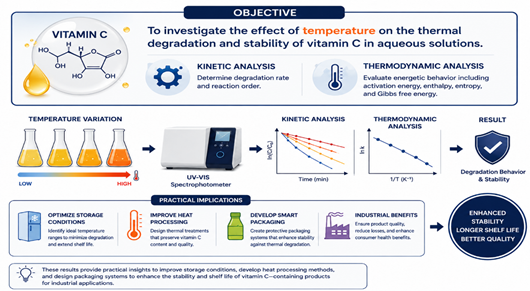
Vitamin C is an important antioxidant used extensively in pharmaceutical, food and cosmetic industries for its vital biological functions. But it is extremely prone to heat, light and oxygen–resulting in quick degradation and loss of efficacy throughout processing and storage. In this study, the thermal degradation, kinetic and thermodynamic stability analysis of vitamin C at different temperature in aqueous solutions were evaluated by UV–VIS spectrophotometry. The feasibility was investigated for vitamin C solutions at concentrations of 0.8% and 0.6% (w/v), with temperatures from 25 to 45 °C, over a time span of 5 to 25 minutes. The λmax was at 285 nm, with a decreasing absorbance as the temperature and exposure time increased indicated an increment of thermal degradation. The degradation process was characterized by first-order kinetic at all temperatures studied. According to results, the activation energy values were determined as 84.35 and 94.05 kJ mol⁻¹ for solutions of 0.8% and 0.6%, respectively, which highlighted a strong temperature effect on the degradation rate. Thermodynamic parameters showed positive values for enthalpy and entropy, suggesting that the degradation process is endothermic (ΔH > 0) and favors disorder in their molecular surroundings. Moreover, Gibbs free energy decreased with increasing temperature that the degradation process was increasingly spontaneous at higher temperatures. Overall, the findings offer useful practical insights towards optimizing storage conditions, improving thermal processing methods and possibly designing packaging systems to enhance stability and shelf life of products containing vitamin C for industrial purposes.
Downloads
Downloads
Published
Issue
Section
License
Copyright (c) 2026 Hajir Awadh, Nuri Abduali

This work is licensed under a Creative Commons Attribution-NonCommercial 4.0 International License.
This journal uses Creative Commons Attribution-Noncommerical 4.0 International License (CC BY-NC 4.0), which permits use, sharing, adaptation, distribution and reproduction in any medium or format, as long as you give appropriate credit to the original author(s) and the source, provide a link to the Creative Commons license, and indicate if changes were made. To view a copy of this license, visit https://creativecommons.org/licenses/by-nc/4.0/.
Copyright of articles
Authors retain copyright of their articles published in this journal.