AI-Enhanced Reservoir Storage Assessment and Depletion Forecasting Using Multispectral Satellite Imagery and Hydrological Modeling
DOI:
https://doi.org/10.63318/waujpasv4i2_36Keywords:
Reservoir Storage, Sentinel-2, Deep Learning, Hydrological Modeling, Water Depletion, Remote Sensing, Artificial IntelligenceAbstract
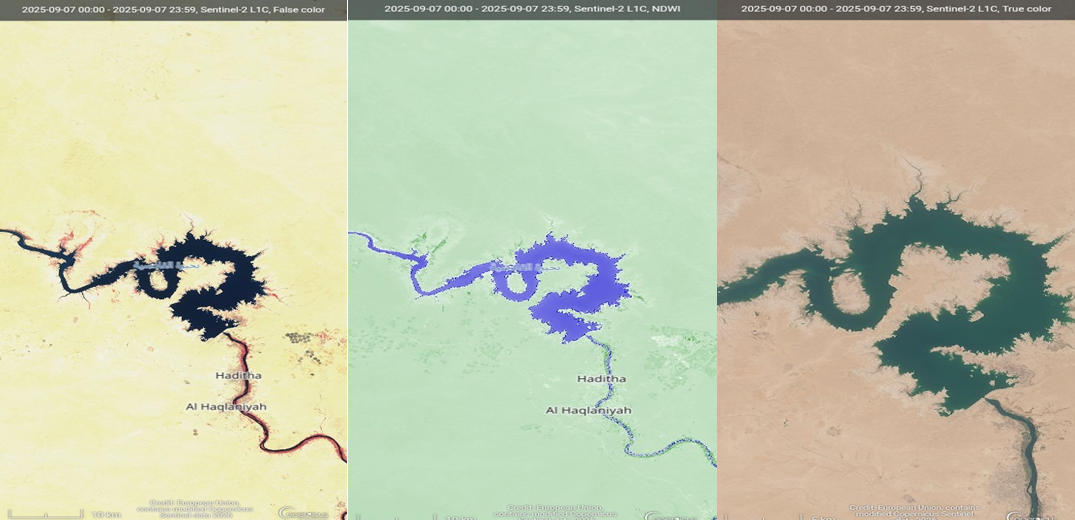
The study suggests a novel AI-based approach for water-storage estimation in reservoirs and for forecasting depleted water levels, using multispectral data from satellites and hydrological models. Sentinel-2 data observed over Haditha Lake (Iraq) on 7 September 2025 was processed with machine-learning and deep-learning algorithms for water surface delineation and water level and water depletion forecasting were applied using predictive models. For the water-surface classification, the U-Net model was tested with an overall accuracy of 96.8%. For the water-level prediction, the predictive model used was an ensemble of water-level predictive models, whose water-level prediction error (RMSE = 0.19 m) was smallest among the models evaluated. Based on the AI derived evaluation, current reservoir storage is estimated to be around 2.80 billion m³ or equivalent to 25.2% of the original reservoir storage. The flow conditions that were evaluated (inflow: 194 m³/s; outflow: 375 m³/s) resulted in a remaining time of 5.9 months (with a 95% confidence interval of 5.6–6.2 months) according to the depletion-prediction model. The proposed framework illustrates how satellite-image analysis, predictive modeling and uncertainty quantification can be combined for monitoring and decision making on reservoirs. The estimates of storage and depletion, however, should be considered model-based and should be further validated based on independent field observations.
Downloads
Downloads
Published
Issue
Section
License
Copyright (c) 2026 The author

This work is licensed under a Creative Commons Attribution-NonCommercial 4.0 International License.
This journal uses Creative Commons Attribution-Noncommerical 4.0 International License (CC BY-NC 4.0), which permits use, sharing, adaptation, distribution and reproduction in any medium or format, as long as you give appropriate credit to the original author(s) and the source, provide a link to the Creative Commons license, and indicate if changes were made. To view a copy of this license, visit https://creativecommons.org/licenses/by-nc/4.0/.
Copyright of articles
Authors retain copyright of their articles published in this journal.