Geochemical Approaches to Combating Desertification and Enhancing Sustainable Development in Libya
DOI:
https://doi.org/10.63318/waujpasv4i2_19Keywords:
Combating Desertification, Geochemical Approaches, Remote Sensing, Geographic Information System, Sustainable Development, LibyaAbstract
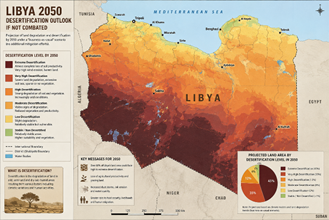
One of Libya's biggest environmental problems is desertification, which is caused by the country's arid and semi-arid climate, low rainfall, high temperatures and evaporation, drought, groundwater depletion, soil salinization, wind erosion, vegetation degradation, and unsustainable land-use practices. The potential of geochemical methods for comprehending, tracking, and preventing desertification as well as promoting sustainable development in Libya is assessed in this study. In order to examine climatic and environmental changes from 2000 to 2025 and their implications for future desertification, the study combines geochemical examination of soil and groundwater with satellite remote sensing and spatial analysis. Temperature, rainfall, and vegetation-cover variations were investigated using MODIS Terra land surface temperature (LST), NASA GPM IMERG precipitation, and Landsat data. With average July LST rising from roughly 29.6°C in 2000 to 34.3°C in 2025 and yearly rainfall falling from 98.6 to 55.2 mm, the results show a significant warming trend. Additionally, there is a general decrease in vegetation cover, especially in inland agricultural areas, oasis systems, and portions of mountainous and coastal regions. By 2050, almost 80% of Libya's geographical area might undergo high to intense desertification, according to a business-as-usual forecast. For evaluating soil fertility, salinity, nutrient availability, pollutant movement, groundwater quality, water–rock interactions, and seawater intrusion, geochemical techniques offer useful instruments. As a foundation for sustainable land and water management, the study highlights the combination of geochemistry, remote sensing, GIS, sophisticated analytical technologies, isotopic techniques, and data science.
Downloads
Downloads
Published
Issue
Section
License
Copyright (c) 2026 The authors

This work is licensed under a Creative Commons Attribution-NonCommercial 4.0 International License.
This journal uses Creative Commons Attribution-Noncommerical 4.0 International License (CC BY-NC 4.0), which permits use, sharing, adaptation, distribution and reproduction in any medium or format, as long as you give appropriate credit to the original author(s) and the source, provide a link to the Creative Commons license, and indicate if changes were made. To view a copy of this license, visit https://creativecommons.org/licenses/by-nc/4.0/.
Copyright of articles
Authors retain copyright of their articles published in this journal.